Your School’s Best Stories Are Disappearing. Here’s How to Save Them.

Every day, something worth sharing is happening at your school.
A student tries something for the first time and discovers a talent she didn’t know she had. A teacher finds a new way to demonstrate a concept that finally makes it click. A team loses a tough match and comes back the next week with something to prove. A senior does something simple and generous that nobody asked him to do.
These moments are your marketing. They’re the proof behind every claim you make about your school; the specificity that separates your story from every other school’s story. And too often, they disappear before they are shared — because there’s no system for capturing them.
That’s what a School Story Bank is for.
What Is a School Story Bank?
A Story Bank is a living document — a shared, running collection of real stories, examples, and moments from your school, organized so they’re actually usable when you need them.
Not a folder of press releases. Not a shared drive full of photos no one can find. A simple, structured resource that gives your whole communications and admissions team something to pull from — specific, real, on-brand examples — whenever they need to make a point, connect with a family, or bring your school’s story to life.
The key word is organized. A list of random stories isn’t a strategy. You need a Story Bank that’s rooted in your Master School Story.
Story Pillars: The Foundation of Your Story Bank
The easiest way to create your Story Bank is to make a spreadsheet — and if you’ve developed a Master School Story, your Story Pillars can help you organize all of the details that make your story true.
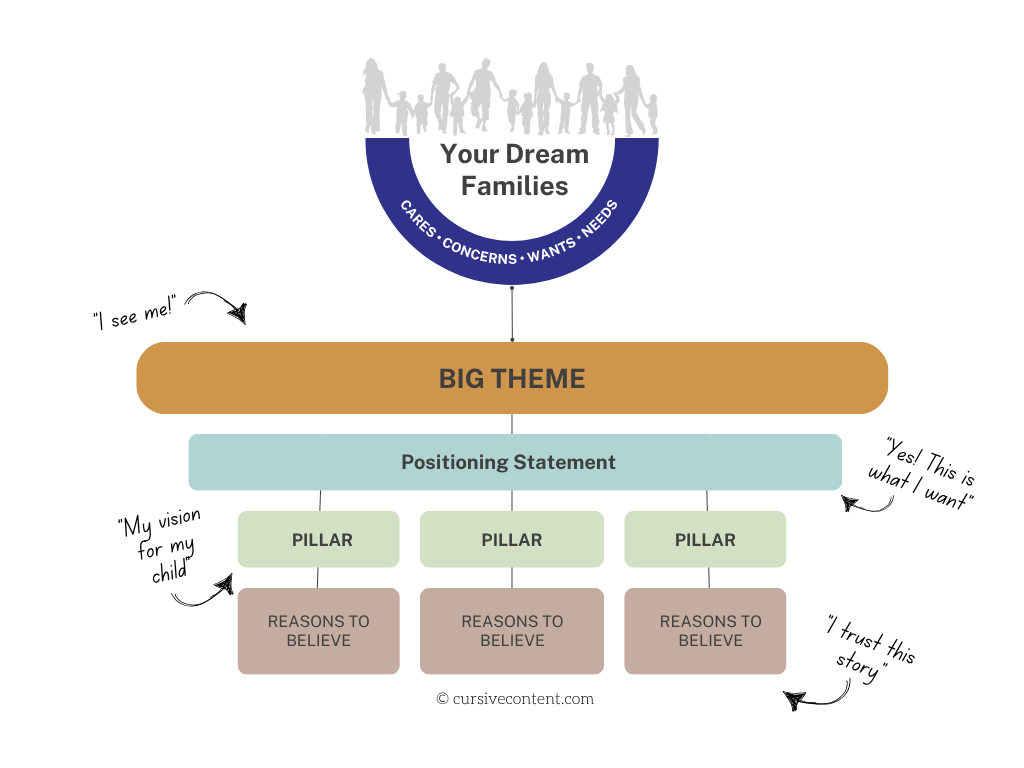
Story Pillars are the outcomes your school produces, the experiences only your students have, the things that make a family say yes, this is the place. So when you are building your Story Bank, make your Story Pillars your column headers.
Now every story you collect has a home — filed under the pillar it brings to life.
For example, if one of your pillars is Purpose, what are the real examples of students finding their purpose? The freshman who tried ceramics for the first time and fell in love. The junior who used her math skills to start tutoring younger students on Thursday afternoons. The senior who couldn’t find the club she was looking for, so she built it. Those are your Purpose stories.
What Goes in the Bank?
When your marketing team publishes a news story or blog post, add a link to the bank. When a coach files a game recap or a teacher sends a note about a student breakthrough, it goes in the bank. When a photo essay goes up on social media, put it in the bank. Your Story Bank grows every time your school tells a story, which means it can grow constantly if you let it.
Your Story Pillars are claims. Your Story Bank is the proof.
When you’re writing admissions copy and you need a specific example to make a line land, the bank gives you one. When a prospective family is touring and a parent mentions that their daughter is passionate about environmental science, the admissions officer doesn’t have to wing it — she can draw on a real catalog of students who’ve done exactly that kind of work at your school.
The bank gives you the ammunition. And in marketing, specificity is everything.
Make your Story Bank a Living Document
A Story Bank only works if it grows. That means it can’t live with one person.
Share it with division heads. Give teachers edit access. Invite coaches and theater directors and music instructors to add notes. The people closest to students are the ones watching your story happen in real time — they just don’t always know that’s what they’re doing.
When you frame it to say, “You’re not submitting content, you’re adding to the school story,” you change what contributing feels like.
Set a light cadence. Once a month, a simple nudge: Anything worth adding to the Story Bank this week? Keep the barrier low. It doesn’t have to be polished. It just has to be real.
MORE ARTICLES
-
 The Truth About AI and School Website Copy (It’s Not What You Think)
 -
 How AI Search Actually Reads Your Private School’s Website
 -
 Two Ways to Use AI for School Storytelling (and Why Most Schools Skip the Important One)
 -
 Your Dream Families Are Already Writing Your Best Copy
 -
 The Hidden Gap Between Your Mission Statement and Enrollment Growth
 -
 Why “Strong Academics & Caring Community” Aren’t a School Story
 -
 Busy, Scattered, Exhausting: What’s Really Wrong With Your School Marketing
 -
 Why Most Schools Don’t Actually Have a Clear Story